Coherence Premium
When the whole system performs better than its parts
Organizations often search for a single source of superior performance: a strong brand, distinctive technology, talented people or efficient operations. These elements matter, but their value depends on how they fit together. A capability that supports one strategy may undermine another. A measure that improves local performance can weaken the customer proposition. An attractive initiative can consume resources required by the organization’s real advantage.
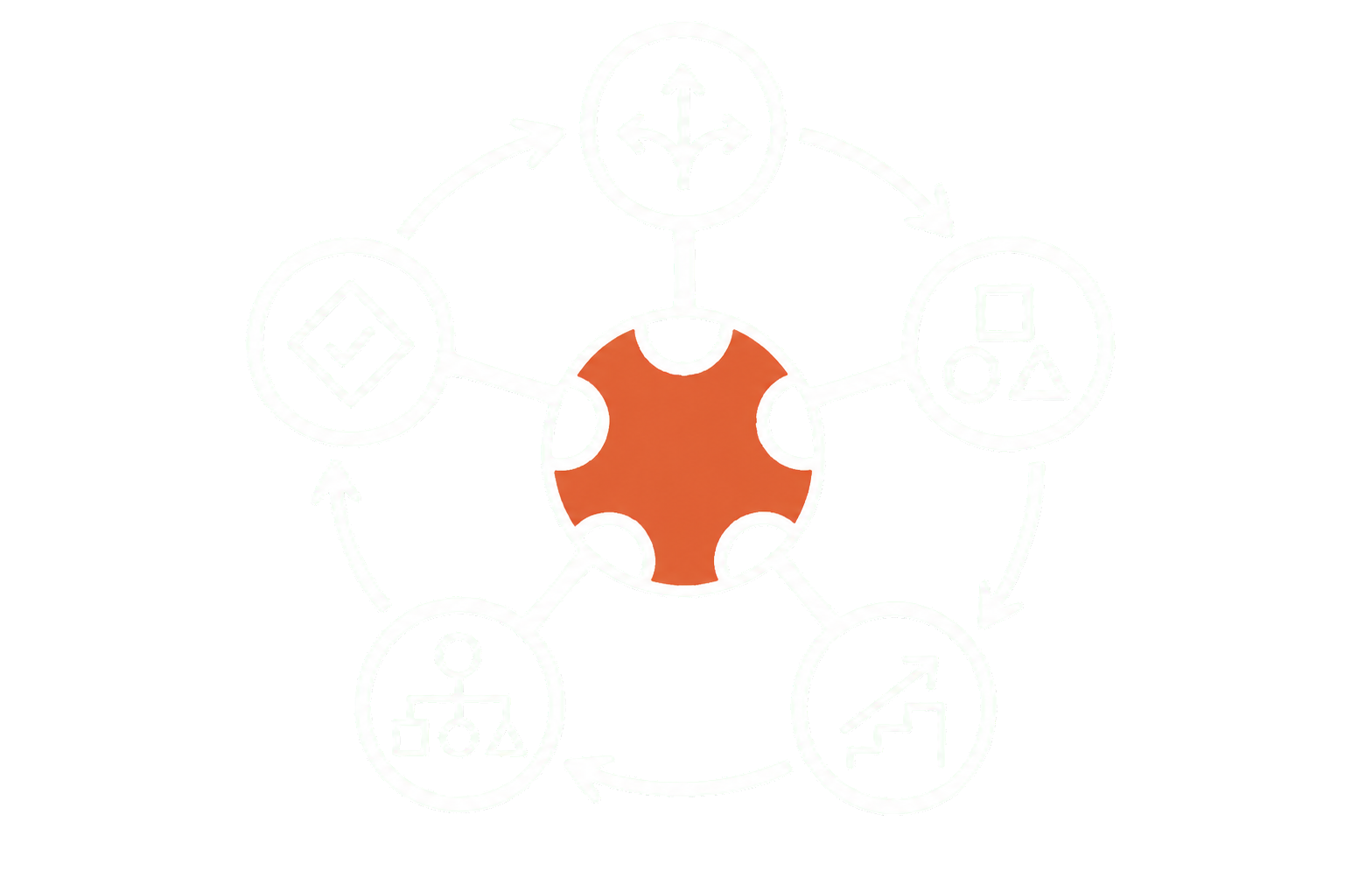
Coherence Premium is the superior performance generated when strategy, resources, capabilities, operating model and decisions consistently reinforce one another. The premium is created through interaction. Each element increases the effectiveness of the others, producing an outcome that isolated improvements could not achieve.
Coherence creates a premium because the organization does not have to overcome contradictions within its own system before it can compete.
Where this principle sits
Coherence Premium belongs to the Sustaining Advantage family of principles and represents the outcome at the heart of the Theory of Strategic Coherence. Focus Multiplier concentrates resources, Capability Compounding strengthens what the organization can repeatedly do and Strategic Momentum converts progress into reinforcing commitment. The Coherence Premium emerges when these forces connect across the full operating system.
Coherence does not mean uniformity or the absence of tension. Organizations need different expertise, debate and local adaptation. The requirement is that these differences resolve into choices and actions that support a common way of creating value.
The central question is: do the organization’s major choices and operating mechanisms increase one another’s effectiveness, or force people to compensate for contradiction?
Contradiction is an invisible tax on performance
An incoherent organization can contain many individually strong components. It may have excellent people, advanced technology and ambitious plans. Yet performance remains lower than expected because those components point in different directions. Teams spend time reconciling measures, negotiating priorities and working around systems designed for another strategy.
Coherence removes this tax. When the customer proposition, capabilities and operating model fit, ordinary decisions become easier. People understand which trade-offs to make. Resources flow toward work that strengthens the same advantage. Measures reinforce the behaviors required by the strategy, and improvement in one area increases value elsewhere.
The premium appears in several forms. Execution is faster because fewer decisions require escalation. Investment produces greater returns because capabilities are reused across related activities. Customer experience becomes more consistent because functions are not optimizing conflicting outcomes. Learning compounds because evidence from one part of the system informs decisions throughout it.
Coherence also increases defensibility. Competitors can copy a product feature, price or individual practice. Replicating a connected activity system is harder because the value lies in the relationships between choices. A rival must reproduce several capabilities, accept the same trade-offs and change its existing operating model. Copying one element without the others may add cost without delivering the intended benefit.
The risk is that coherence can become rigidity. A tightly connected system may resist change because altering one choice affects many others. Leaders must therefore distinguish between coherence around an enduring value-creation logic and attachment to historical practices. Sustaining the premium requires renewal of the system as conditions change, not preservation of every component.
How coherence creates a premium
The premium develops when the organization designs and manages several layers as one system.
A clear value-creation logic sets direction
Leaders define where the organization will compete, for whom and how it will create distinctive value. This provides the test for subsequent choices. Without a clear logic, alignment becomes agreement around broad ambitions rather than coordination around a strategy.
Trade-offs protect the model
Coherence requires saying no to opportunities and practices that conflict with the chosen way of winning. An activity may be attractive on its own but harmful if it introduces complexity, changes the cost structure or pulls capabilities away from the core proposition.
Activities are mutually reinforcing
The customer promise, product design, channels, operations and service model support one another. An efficient process enables a lower price; a simpler product reduces operating complexity; reduced complexity improves reliability. The combined effect is greater than the contribution of each practice.
Resources and capabilities follow the choices
Budgets, talent and leadership attention concentrate on the capabilities the strategy requires. The organization does not claim one direction while continuing to fund the assumptions of another. Repeated investment allows strategically relevant capabilities to compound.
Structure and decision rights support the flow of value
Roles, teams and authority are organized around the outcomes the strategy needs. Dependencies are managed deliberately, and decisions sit close enough to relevant information to move at the appropriate speed.
Measures reinforce the same outcome
Enterprise, functional and individual measures are connected. Local targets do not reward behaviors that undermine the customer proposition or shift cost elsewhere. The measurement system helps people resolve trade-offs consistently.
Feedback renews the whole system
Leaders examine whether assumptions remain valid and whether changes in one element require changes elsewhere. Coherence is maintained through coordinated adaptation. Adding a new channel, technology or customer segment should trigger a review of capabilities, processes and measures—not simply another initiative.
These mechanisms create three forms of fit. Choices are consistent with the strategic position. Activities reinforce one another. The overall system is optimized so that effort is not duplicated or wasted. As fit deepens, performance improves and imitation becomes more difficult.
Southwest Airlines: the advantage of a reinforcing activity system
Southwest Airlines offers a classic historical example of the Coherence Premium. Its low-fare proposition was supported by an interconnected operating model rather than a single cost-saving practice. The company combined a point-to-point network, use of a single aircraft type, service through many less-congested airports and an emphasis on productive operations.
Each choice strengthened the others. A single aircraft type simplified maintenance, scheduling, training and flight operations. Point-to-point routes reduced dependence on complex hub connections. Less-congested airports supported aircraft utilization by reducing ground time. Greater simplicity and utilization supported a cost structure capable of offering lower fares.
The advantage was not located in any one activity. Another airline could operate a Boeing 737 or serve a secondary airport. The premium came from fit across the system. The route structure, fleet, operating routines, employee productivity and customer proposition made sense together. Removing one element could reduce the value of several others.
The model also involved trade-offs. A system designed for simplicity and low cost could not offer every feature, connection or service configuration available from a full-service network carrier without introducing contradiction. Strategic discipline meant protecting the relationships that made the model work, not copying every attractive practice in the market.
Southwest’s more recent changes also illustrate the need to renew coherence. When customer expectations, economics or competition change, an organization may need to alter elements of a historically successful model. The challenge is to redesign the connected system deliberately. Adding changes independently can erode fit; coordinated adaptation can establish a new source of coherence.
The lesson for leaders is to map the activities behind performance and examine the links between them. A strategy is strongest when the organization can explain not only why each choice matters, but how each choice increases the effectiveness of the rest.
Advantage comes from fit across choices
Michael Porter provides the central foundation for the Coherence Premium in Competitive Strategy and his broader work on competitive positioning. Strategy requires a distinctive position, explicit trade-offs and fit among activities. Operational effectiveness can improve individual practices, but sustainable advantage depends on performing a connected set of activities in a way that creates distinctive value.
Fit strengthens advantage in several ways. Consistency ensures that activities do not contradict the position. Reinforcement means the value of one activity is increased by another. Optimization removes duplication and coordinates effort across the system. The deeper the fit, the harder it becomes for a competitor to imitate the strategy through a single copied feature.
Roger Martin translates this logic into an integrated choice system in Playing to Win. Where-to-play and how-to-win choices determine the capabilities the organization needs and the management systems required to sustain them. A strategy is incomplete if aspiration and market choices are disconnected from resource allocation, structures and measures.
Together, these perspectives explain why coherence is more than alignment around a plan. The customer proposition, activity system and management system must support the same logic. Leaders create the premium by designing those relationships and protecting the trade-offs that hold them together.
They also reveal why coherence must be dynamic. When the diagnosis or position changes, capabilities and systems must change with it. Updating only the strategic narrative while preserving the old operating model creates contradiction rather than renewal.
Signals to watch
- The customer promise depends on capabilities the organization does not consistently fund.
- Functional targets improve while the end-to-end customer or enterprise outcome deteriorates.
- New initiatives are approved without testing whether they reinforce the activity system.
- Teams spend substantial effort reconciling contradictory priorities, measures or processes.
- Competitors can copy individual features without needing to reproduce the wider model.
- The organization describes many strengths but cannot explain how they connect.
- Resources remain tied to capabilities required by a previous strategy.
- Changes to one part of the model are made without redesigning the dependent elements.
Questions for leaders
- What is the organization’s distinctive logic for creating value?
- Which activities are essential to that logic, and how do they reinforce one another?
- What trade-offs protect the integrity of the system?
- Do resource allocation and capability investment match the stated strategy?
- Which structures, measures or incentives still support an earlier model?
- Where does local optimization create contradiction for the whole organization?
- What could competitors copy easily, and what would require them to reproduce the connected system?
- If one strategic choice changes, which other elements must be redesigned with it?
The takeaway
The Coherence Premium is the superior performance created when strategic choices, resources, capabilities, activities and management systems reinforce the same value-creation logic. It improves execution, compounds learning and makes advantage harder to imitate because the value resides in the connected system.
Exceptional performance rarely comes from one exceptional element. It comes from an organization whose important elements make one another stronger.