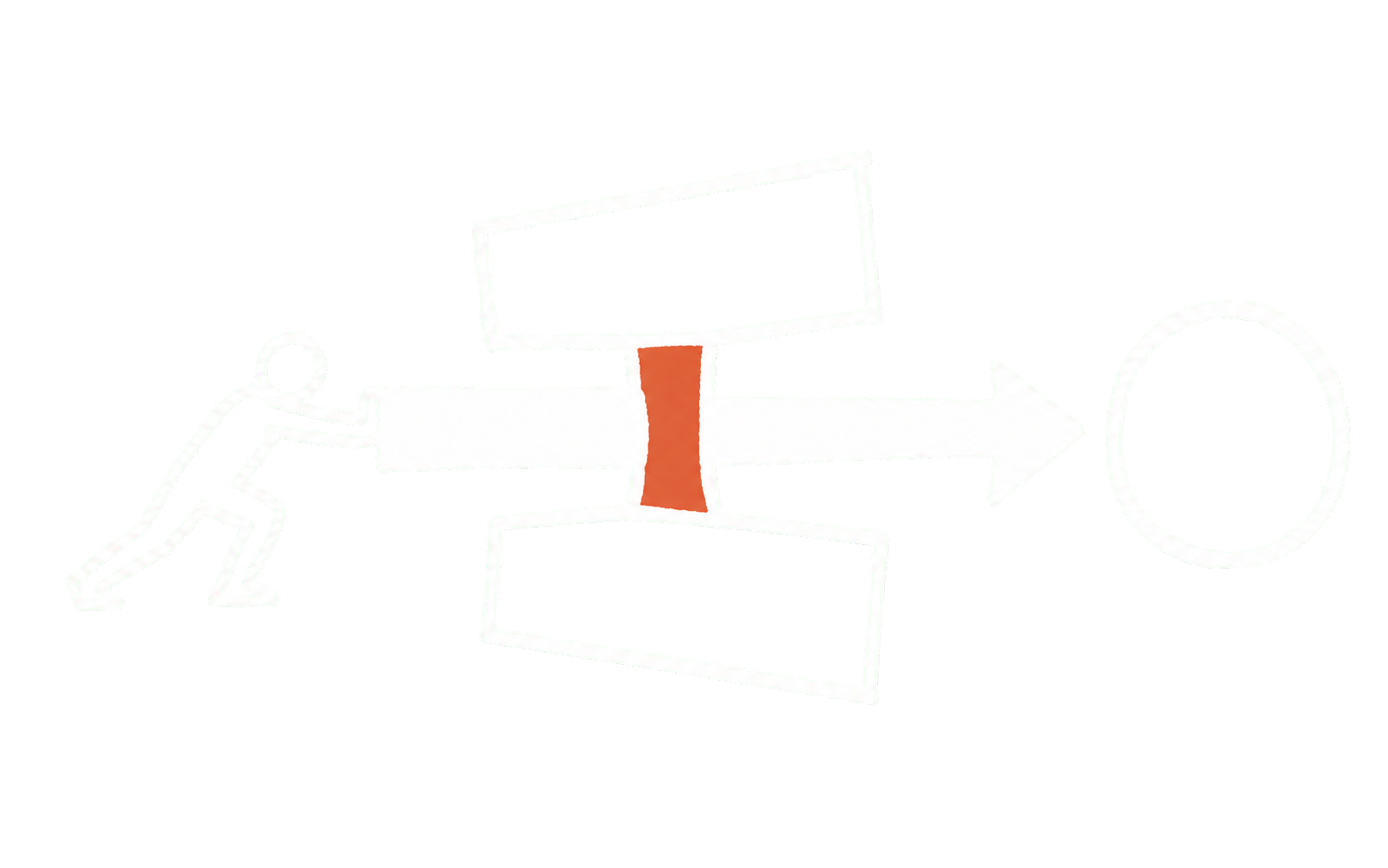
Strategic Friction
When the organization resists its own strategy
Most strategies do not fail because people cannot understand them. They fail because the organization makes the chosen work unnecessarily difficult to do. A priority may be clear, yet every decision still requires several approvals. A team may be accountable for an outcome, yet lack control over the people, data or budget needed to produce it. Leaders may ask for speed while processes continue to reward caution, completeness and local compliance.
Strategic Friction is the avoidable resistance created when an organization’s structures, processes, incentives, information flows or behaviors work against its stated strategic choices. It is the distance between what the strategy asks people to do and what the operating environment makes easy, safe and rewarding.
A strategy becomes real only when the organization makes the strategically important work easier to perform than the alternatives.
Where this principle sits
Strategic Friction belongs to the Losing Focus family of principles. It is related to Dilution Drag, which describes the loss of force caused by too many priorities, and Strategic Entropy, which describes the gradual drift of an organization away from coherent intent. Friction is different: the priority may still be understood, but the system surrounding it resists execution.
The central diagnostic question is simple: where does the organization make its own strategy harder than it needs to be?
The cost is more than delay
Friction is often dismissed as bureaucracy, inconvenience or the normal cost of scale. That understates the problem. Repeated resistance changes behavior. Teams stop proposing ideas because approval is too difficult. Managers build private workarounds because shared processes are too slow. People optimize for the measures they can control rather than the outcomes the strategy requires. Over time, the organization becomes better at navigating itself than serving its purpose.
The visible costs are slower decisions, duplicated work and missed deadlines. The deeper costs are weaker learning and declining confidence. When every experiment takes months to authorize, evidence arrives too late to guide the next decision. When accountability crosses several functions, failure can always be attributed elsewhere. When leaders repeatedly announce priorities without removing the barriers around them, employees learn that stated strategy and operating reality are separate things.
Not all friction is harmful. Some constraints protect safety, quality, fairness, security or reputation. Useful friction slows action at the point where care is strategically valuable. Harmful friction persists without a clear purpose, applies the same control to decisions with very different risks, or protects yesterday’s assumptions at the expense of today’s choices. The aim is not a frictionless organization. It is an organization in which resistance is deliberate, proportionate and aligned with strategy.
How strategic friction accumulates
Strategic Friction rarely comes from one obviously broken rule. It builds through several reasonable decisions that no longer work together.
Structure contradicts the priority
The organization declares an end-to-end outcome important, but authority remains divided by function, geography or product. Each unit controls only part of the work and protects its own targets. Coordination becomes negotiation, and the strategy advances only when several local interests happen to align.
Processes preserve yesterday’s risks
Approval paths, planning cycles and governance forums are usually created for a reason. They become friction when they outlive that reason or treat every decision as equally consequential. Low-risk experiments travel through the same machinery as irreversible commitments. The process becomes a substitute for judgment.
Incentives reward local success
People follow the signals embedded in goals, budgets and performance reviews. If the strategy calls for collaboration but rewards functional efficiency, collaboration will remain optional. If leaders ask teams to build future capability while evaluating only current-quarter output, urgent work will continually displace important work.
Dependencies multiply coordination costs
A strategic initiative that depends on many teams, systems and decision makers has more points at which it can stop. Every hand-off introduces waiting, interpretation and competing priorities. As dependencies grow, progress depends less on the quality of the idea and more on the ability of sponsors to escalate around the system.
Workarounds become the operating model
Capable people compensate for friction. They create spreadsheets outside core systems, seek informal approvals, borrow staff, hold pre-meetings before formal meetings and rely on personal relationships to move work. These actions can produce short-term progress, but they conceal the underlying design problem. When the workaround becomes normal, the organization mistakes heroic effort for effective execution.
The pattern is self-reinforcing. Friction slows delivery; leaders respond with more oversight; more oversight adds meetings, reports and approval points; teams then spend even less time on the work itself. Breaking the cycle requires changing the system, not asking people to push harder through it.
Toyota: designing the system for flow and learning
Toyota offers a useful example because its operating philosophy does not simply remove every obstacle. It distinguishes wasteful resistance from purposeful controls that improve quality and learning. Standardized work, visual management and close attention to flow reduce ambiguity and make problems easier to see. At the same time, practices such as stopping production when a defect appears introduce deliberate friction at exactly the point where continuing would create greater cost.
This distinction matters. A conventional response to a production problem may be to keep the line moving and repair defects later. That protects short-term output while allowing the cause to remain hidden. Toyota’s approach makes the interruption visible, brings support to the point of work and treats the problem as information about the system. The pause is not bureaucracy; it is a strategic choice to protect quality and strengthen capability.
The broader lesson is that flow does not mean speed at any price. It means removing waiting, rework, overburden and unnecessary hand-offs while preserving controls that serve the organization’s purpose. The influence of systems and quality thinkers such as W. Edwards Deming reinforces the same idea: performance is shaped less by isolated effort than by the design of the system in which people work.
Leaders can apply the lesson beyond manufacturing. Map how a strategically important decision, customer request or experiment moves through the organization. Identify where it waits, returns for rework, loses ownership or requires escalation. Then ask which points protect something valuable and which merely reflect inherited design.
A systems lens on organizational resistance
Donella Meadows provides the clearest intellectual foundation for understanding Strategic Friction. In Thinking in Systems, she shows that recurring behavior emerges from structures: stocks and flows, feedback loops, delays, rules and information. When an organization repeatedly produces slow decisions, defensive behavior or local optimization, the most useful question is not “Who is resisting?” but “What structure keeps producing this result?”
This changes the leadership response. A communication campaign cannot compensate for incentives that point in the opposite direction. A new priority cannot move quickly through an approval system designed to prevent variation. More accountability will not solve work whose ownership is fragmented across several functions. The leverage lies in changing the conditions that shape behavior.
Eliyahu Goldratt develops a complementary idea in The Goal: overall performance is governed by constraints, and improving activity away from the constraint may create motion without improving the system. Applied strategically, the lesson is to find the few points of resistance that govern the flow of important work. Removing ten minor irritants is less valuable than redesigning the approval, dependency or incentive that repeatedly limits progress.
Signals to watch
- Strategic initiatives require repeated senior escalation to make ordinary progress.
- Teams spend more time preparing approvals and status reports than testing or delivering work.
- Accountability is assigned to people who do not control the required resources or decisions.
- Low-risk experiments are governed like large, irreversible investments.
- Employees rely on personal relationships and unofficial workarounds to navigate core processes.
- Cross-functional work repeatedly stalls at hand-offs between teams.
- Performance measures reward local efficiency while the strategy requires shared outcomes.
- The same obstacles appear in retrospectives, but ownership for removing them remains unclear.
Questions for leaders
- Which strategically important work is harder to complete than routine business-as-usual activity?
- Where does that work wait, loop back, lose ownership or require escalation?
- Which controls protect a genuine risk, and which survive mainly through habit?
- Do people have authority over the outcomes for which they are accountable?
- What do incentives and resource-allocation choices tell people to prioritize in practice?
- Which single constraint most limits the flow of strategic work today?
- What could be removed, simplified or moved closer to the point of action without weakening necessary safeguards?
The takeaway
Strategic Friction is not evidence that people need more motivation. It is evidence that the organization’s design and its strategy are out of alignment. Leaders reduce it by tracing how important work actually moves, distinguishing purposeful safeguards from inherited resistance, and redesigning the few constraints that shape the whole system.
Do not ask the strategy to overpower the operating model. Change the operating model so that it carries the strategy.