Strategic Momentum
When progress begins to reinforce itself
Strategic change is usually hardest at the beginning. The direction may be clear to leaders but unproven to everyone else. Capabilities are incomplete, early results are uncertain and established work still has stronger routines and constituencies. The organization must invest before the new strategy has earned confidence.
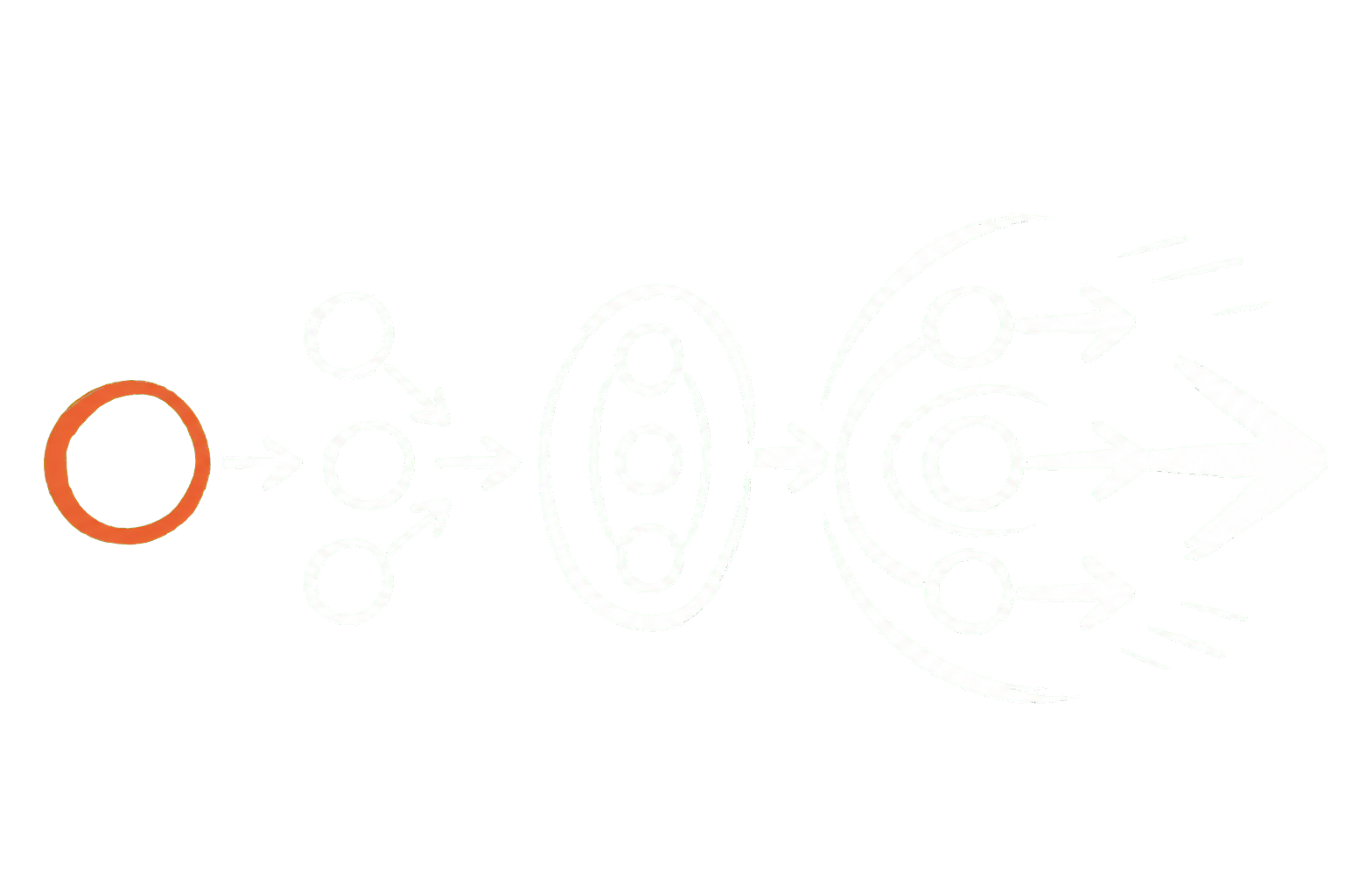
Strategic Momentum is the self-reinforcing progress created when clear choices, aligned resources and visible results increase confidence, commitment and execution speed. Momentum develops when each cycle of action makes the next cycle easier: evidence strengthens belief, belief attracts resources, resources improve capability and stronger capability produces better results.
Momentum begins when progress stops depending entirely on leadership pressure and starts generating its own organizational energy.
Where this principle sits
Strategic Momentum belongs to the Sustaining Advantage family of principles. It often follows Focus Multiplier and Capability Compounding. Concentrated effort creates results; repeated learning strengthens capability; visible progress then encourages deeper commitment to the same coherent direction.
Momentum is different from activity, enthusiasm or short-term growth. A launch can create excitement without changing the organization’s ability to perform. Genuine momentum persists because the operating system, capabilities and resource decisions increasingly support the strategy. It can survive the end of a campaign or the departure of an individual sponsor.
The central question is: what evidence and reinforcing mechanisms would cause commitment to the strategy to grow with each cycle of execution?
Strategies weaken when every cycle requires renewed persuasion
Without momentum, strategic execution remains dependent on continuous intervention. Leaders must repeatedly explain the same priority, renegotiate resources and escalate around existing systems. Teams treat the strategy as an additional initiative rather than the organization’s emerging way of working. Progress occurs, but it is fragile and expensive to maintain.
Visible evidence changes the organizational calculation. When customers respond, delivery improves or a new capability produces measurable value, the strategy becomes less abstract. People can connect their effort to an outcome. Sponsors become more willing to commit resources, skeptical teams begin to participate and decisions that once required escalation become easier.
Momentum also improves coordination. A clear direction supported by credible progress provides a stronger decision rule. Teams can align local priorities without waiting for detailed instruction because they understand where the organization is going and can see that the commitment is real. This reduces Alignment Debt and increases execution speed.
The absence of momentum has the opposite effect. Delayed results weaken confidence, weaker confidence reduces investment and reduced investment makes results less likely. Leaders may respond by changing direction prematurely, launching new initiatives or increasing communications. These actions fragment attention and create a negative loop in which the strategy never receives sustained support long enough to prove itself.
Momentum therefore matters most during the transition between strategic intent and institutional commitment. Early progress should not be confused with final success, but it can provide the evidence and energy required to continue through uncertainty. Leaders must design for credible proof while protecting the longer-term capabilities on which durable advantage depends.
How strategic momentum builds
Momentum is produced by a reinforcing system, not a single motivational event. Several mechanisms combine to turn initial progress into sustained energy.
The direction is specific enough to guide action
People need to understand the choices beneath the ambition: which customers, outcomes and capabilities matter, and what will receive less attention. A broad aspiration cannot create momentum because teams cannot tell whether their local decisions reinforce it.
Resources reach a meaningful level
Early work must have enough talent, authority and funding to produce credible evidence. Underpowered initiatives generate weak results that appear to disprove the strategy. Concentration allows the organization to demonstrate what the choice can achieve when properly supported.
Progress is visible and strategically relevant
Measures should show movement in the logic of the strategy, not merely completion of tasks. Customer adoption, cycle-time improvement, capability growth or better unit economics can demonstrate that the new model is becoming more viable. The evidence must be close enough to action to guide the next decision.
Results are reinvested
Momentum strengthens when early gains fund or justify the next capability, market or improvement. If benefits are immediately absorbed into unrelated priorities, the reinforcing loop is broken. Reinvestment signals that progress increases commitment rather than inviting resource extraction.
Successful practices become easier to repeat
Teams codify learning, reuse tools and improve the operating model. Each cycle then requires less exceptional effort. What began as a special initiative becomes a reliable capability, allowing progress to continue without constant senior intervention.
Stories and identity follow the evidence
Credible examples help people understand the strategy and see their role within it. Stories become powerful when they explain real choices and outcomes, not when they substitute for them. As success becomes part of organizational identity, commitment can outlast the original program.
Leaders protect direction without ignoring new evidence
Momentum requires consistency, but it can become inertia if success makes leaders defensive. The organization must preserve the reinforcing system while continuing to test assumptions and watch for changing conditions. The objective is sustained learning in a clear direction, not permanent attachment to yesterday’s formula.
The loop is cumulative: focused action creates proof; proof increases confidence; confidence attracts commitment; commitment strengthens capability; and capability improves the next result. Leaders build momentum by deliberately connecting these stages rather than hoping that success will spread by itself.
Netflix: building momentum from streaming to a new business model
Netflix demonstrates how a company can build momentum through a sequence of connected strategic commitments. Its move from DVD distribution toward streaming required more than launching a digital channel. The company had to develop technology, licensing relationships, customer behavior, recommendation capabilities and eventually original content around a different model of value creation.
Early streaming adoption provided evidence that customers valued immediate, on-demand access. That evidence supported further investment in the platform and content catalog. A stronger service attracted more viewing, which generated richer insight into customer preferences and improved the company’s ability to guide discovery and investment. Progress in one part of the model strengthened the case for the next.
Momentum also required willingness to move resources and organizational attention away from the model that had created the company’s initial success. If streaming had remained a lightly funded addition to the DVD business, it could not have developed the reliability, content and customer experience required to become the core. Strategic commitment became visible through allocation, not only communication.
The transition was not a smooth sequence of uninterrupted wins. Pricing decisions, market reactions, competition and the economics of content created setbacks and required adaptation. Momentum did not mean avoiding mistakes. It meant retaining a coherent direction while learning from evidence and strengthening the capabilities needed for the new model.
The broader lesson is that momentum is built through connected proof. Customer response justifies platform investment; platform improvement increases use; greater use strengthens learning; and learning informs the next content and product choices. Leaders should identify the reinforcing loop their strategy requires, then ensure early results feed the next stage rather than remain isolated successes.
Short-term proof and the flywheel of cumulative progress
John Kotter emphasizes the importance of generating visible short-term wins during significant change. Early results provide more than reassurance. They demonstrate that sacrifice is producing value, weaken resistance, reward contributors and create evidence that further change is achievable.
The implication is not to pursue superficial wins disconnected from the strategy. A credible early result should test an important part of the strategic logic and strengthen the capability needed for later stages. Otherwise, the organization may celebrate activity while leaving the underlying system unchanged.
Jim Collins offers a complementary model through the flywheel: sustained performance emerges from many consistent pushes in a coherent direction rather than one dramatic breakthrough. Each turn builds on the previous one until cumulative effort produces visible acceleration. The insight helps leaders resist the temptation to replace a slow-building strategy with another program simply because no single action feels transformative.
Measure What Matters provides a practical mechanism for connecting direction to visible progress. A small number of clear objectives and measurable key results can show whether strategically relevant movement is occurring, reveal dependencies and support regular learning. Measures create momentum when they guide better decisions and strengthen commitment, not when they become an additional reporting layer.
Together, these perspectives show that momentum combines patience and evidence. Leaders must remain consistent long enough for cumulative effort to matter, while producing proof frequently enough for the organization to learn and maintain confidence. The rhythm is neither endless waiting nor constant reinvention: choose, act, observe, strengthen and repeat.
Signals to watch
- Every phase of the strategy requires the same priorities to be re-explained and renegotiated.
- Early results are celebrated but not reinvested in the next capability or stage.
- Teams report activity without evidence that the strategic logic is strengthening.
- Promising initiatives remain dependent on a small number of senior sponsors.
- Successful practices are not codified, transferred or made easier to repeat.
- New programs repeatedly replace existing strategies before learning can accumulate.
- Confidence falls quickly when the organization encounters a predictable setback.
- Past success is creating inertia and reducing willingness to test current assumptions.
Questions for leaders
- What reinforcing loop must operate for this strategy to build momentum?
- Which early result would provide credible evidence without distorting the long-term objective?
- Are priority initiatives sufficiently resourced to produce meaningful proof?
- How will early gains be reinvested in the next capability or stage?
- What is becoming easier, faster or more repeatable with each cycle?
- Can progress continue without constant senior escalation and persuasion?
- Which stories accurately connect strategic choices to visible outcomes?
- How will leaders distinguish productive consistency from dangerous inertia?
The takeaway
Strategic Momentum is created when clear choices generate visible progress, progress increases confidence and confidence attracts the resources and commitment required for the next stage. Leaders sustain it by reinvesting gains, embedding successful practices and preserving direction while continuing to learn.
Momentum is not a burst of enthusiasm. It is the cumulative force created when each result makes the next strategically coherent action more likely and more effective.