Dilution Drag
Introduction
When too many priorities weaken the whole organization
Every organization has finite attention, capital, leadership capacity and execution capability. Yet many organizations behave as though these resources can be divided indefinitely without consequence.
They add another priority, launch another initiative, enter another market, serve another customer segment or ask an already stretched team to pursue one more opportunity. Each decision may appear individually rational. A persuasive business case can usually be constructed for every new investment.
The problem is not necessarily that any single initiative is wrong. The problem is what happens collectively.
As resources are spread across a growing portfolio of priorities, each priority receives less of what it needs to succeed. Decisions slow. Accountability becomes blurred. Leaders divide their attention. Teams compete for scarce expertise. Work remains unfinished for longer, while the organization’s strongest opportunities are prevented from reaching their full potential.
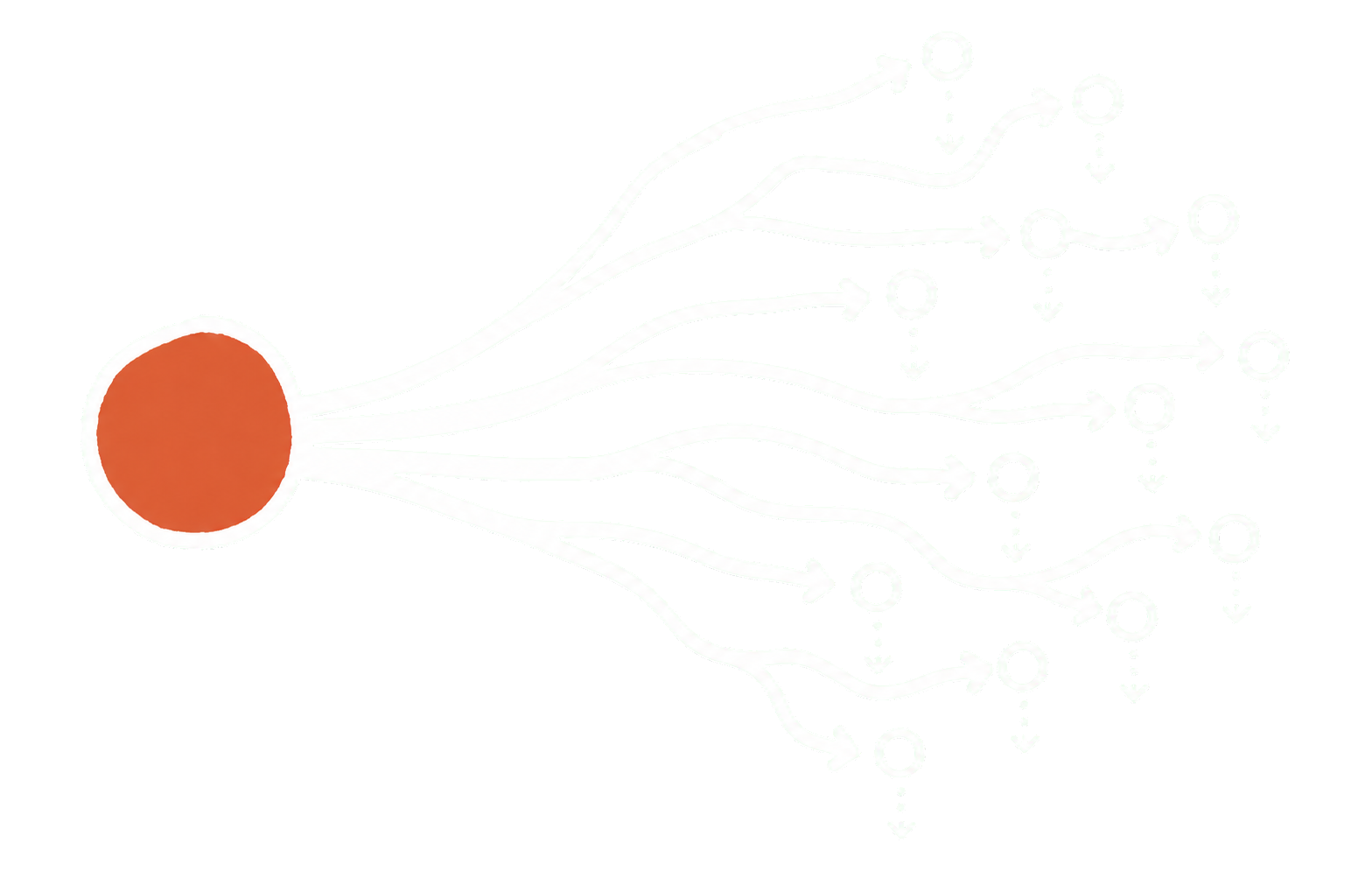
This is Dilution Drag: the cumulative loss of organizational effectiveness that occurs when resources, attention and effort are distributed across too many priorities.
Dilution Drag is rarely visible as one dramatic failure. It appears gradually—in slower execution, weaker outcomes, rising coordination costs and a widening gap between what the organization says matters and where its resources actually go.
The organization remains busy. It may even appear highly ambitious. But its ability to produce meaningful outcomes steadily declines.
Where this principle sits
Dilution Drag is part of the Losing Focus area of the Theory of Strategic Coherence.
The principles in this area explain how organizations drift away from a clear strategy:
Dilution Drag is often the first visible sign that focus is being lost. More work is added than removed, resources become fragmented and execution slows. If this pattern continues, friction accumulates and the organization gradually moves toward strategic entropy.
Has the organization concentrated enough of its resources behind its most important choices for those choices to succeed?
Why It Matters
The central idea
Strategy is not primarily a list of things an organization intends to do. It is a system for concentrating scarce resources on the choices most likely to create distinctive value.
Dilution Drag begins when this concentration breaks down.
Every new priority competes with existing priorities for a limited set of resources:
- Leadership attention
- Skilled people
- Investment capital
- Technology capacity
- Organizational energy
- Decision-making time
- Management oversight
- Customer attention
- The capacity to absorb change
These resources are not perfectly divisible. Dividing a leadership team across twice as many initiatives does not simply give each initiative half the attention. It creates additional meetings, dependencies, decisions, reporting requirements and conflicts.
The cost of adding work is therefore usually greater than the visible cost of the work itself.
An organization might fund ten initiatives at 70 per cent of what each requires. On paper, it has created a diversified portfolio. In practice, it may have created ten underpowered initiatives that struggle to cross the threshold required for success.
Meaningful progress requires concentration. Important priorities must receive sufficient resources, leadership sponsorship and sustained attention to overcome inertia and produce an outcome.
When everything is important, nothing receives that level of commitment.
How It Works
Dilution is rarely the result of careless leadership. It is usually produced by understandable organizational forces.
Opportunities are easier to add than priorities are to remove
New ideas arrive with advocates, forecasts and a compelling story about what might be possible. Existing work has employees, customers, sunk costs and political support.
Approving a new initiative creates optimism. Stopping an existing one creates visible disappointment.
Organizations therefore add more readily than they subtract. The portfolio expands, but the underlying resource base does not expand at the same rate.
Saying no feels riskier than spreading resources
Concentrating resources requires leaders to make choices under uncertainty. Backing one opportunity means accepting that another may be missed.
Leadership teams often respond by preserving optionality across too many areas. They provide partial funding to several initiatives so that no door is completely closed.
This can feel prudent, but it frequently prevents any initiative from generating decisive evidence. The organization maintains many theoretical options without developing the capability to exploit them.
Annual planning encourages accumulation
Planning processes commonly begin by collecting proposals from functions, regions and business units. Each proposal is assessed independently and justified against its own potential benefits.
What is often missing is a rigorous portfolio-level question: What should stop so that the most important work can succeed?
The final plan becomes an aggregation of local priorities rather than an expression of enterprise strategy.
Activity is mistaken for ambition
A long list of transformation programs creates the appearance of momentum. Leaders can point to numerous initiatives, pilots, workshops and workstreams as evidence that the organization is responding to change.
But ambition should be measured by the scale of the outcome pursued, not the number of projects underway.
Highly ambitious organizations are often highly selective. They make fewer commitments, resource them properly and pursue them with unusual intensity.
Resources appear more flexible than they are
A financial model may show that funding has been allocated. This does not mean the organization possesses the practical capacity to execute.
Several initiatives may depend on the same technology teams, commercial leaders, analysts, operational experts or decision-makers. Each project appears adequately resourced when viewed separately, yet collectively they exceed the capacity of the shared system.
The constraint is often not total headcount or capital. It is access to a small number of critical capabilities.
How Dilution Drag develops
Dilution Drag usually progresses through a recognizable sequence.
First, the organization adds priorities without removing existing commitments. Teams initially absorb the pressure through additional effort.
Second, shared resources become bottlenecks. Projects wait for decisions, technical work, specialist input or executive approval.
Third, timelines extend. Because everything remains active, few initiatives are explicitly stopped. Work continues, but at a slower rate.
Fourth, leaders respond to weak progress by adding governance. More meetings, reports and escalation mechanisms are introduced to improve control.
This increases the coordination burden and consumes even more of the scarce attention required for execution.
Finally, the organization normalizes underperformance. Delayed milestones, partial implementations and unrealized benefits become accepted features of organizational life.
At this point, Dilution Drag begins to influence the culture. Employees learn that priorities change frequently, commitments are negotiable and completion is less important than visible participation in the latest initiative.
Evidence in Practice
Apple: subtraction as a strategic act
Apple in the period surrounding Steve Jobs’ return in 1997 provides a powerful example of the relationship between concentration and organizational performance.
The company was pursuing a complicated portfolio of products and projects while struggling to establish a clear direction. Its product range had become difficult for customers to understand and difficult for the organization to manage. Resources and attention were distributed across too many competing activities.
Jobs’ response was not to add another transformation program to the existing portfolio. It was to simplify.
Apple reduced the number of products it would prioritize and organized its core computer offering around a much clearer structure: products for consumers and professionals, with desktop and portable options for each. Projects that did not support the renewed direction were stopped.
The significance of this decision was not merely that Apple produced fewer products. Subtraction changed the economics and operating conditions of the organization.
Engineering capacity could be concentrated. Product decisions became clearer. Marketing could communicate a more coherent proposition. Leadership attention was directed toward a smaller number of important bets. The company had a better chance of making each selected product distinctive because it was no longer attempting to sustain the same degree of complexity.
Apple’s later success cannot be attributed to simplification alone. Design capability, technology, brand, ecosystem development and execution all mattered. But concentration created the conditions in which those capabilities could reinforce one another.
Removing work can increase an organization’s productive capacity even when headcount and capital remain unchanged.
Subtraction releases more than budget. It releases attention, improves decision quality, reduces coordination requirements and allows capability to accumulate around the chosen priorities.
Key Source
Richard Rumelt and coherent action
Richard Rumelt argues in Good Strategy/Bad Strategy that good strategy identifies the central challenge facing an organization and establishes a coherent set of actions for addressing it.
This is different from producing a long list of ambitions.
A collection of targets, projects and desirable outcomes may communicate aspiration, but it does not necessarily resolve the question at the heart of strategy: Where will the organization concentrate its effort?
Rumelt’s concept of coherent action is particularly important. Strategic actions should reinforce one another and direct organizational energy toward overcoming a defined challenge. When initiatives proliferate without this coherence, resources are dispersed across activities that may be individually worthwhile but collectively weak.
Dilution Drag explains the organizational consequence of that dispersion.
It is possible for an organization to have capable people, attractive opportunities and substantial resources while still producing disappointing outcomes. The problem may not be a shortage of effort. It may be the absence of sufficient concentration.
Focus is not created by declaring priorities. It is created by allocating resources in a way that makes the hierarchy between those priorities unmistakable.
Signals to Watch
The most obvious effect of dilution is that individual initiatives receive fewer resources. The deeper costs are systemic.
Slower decisions
More priorities create more trade-offs. Leaders repeatedly decide which work receives scarce capacity without having resolved the underlying strategic choice.
The same resource conflict is settled many times at lower levels instead of once by leadership.
Increased switching costs
People working across multiple priorities lose time as they shift between problems, teams and time horizons. The cost includes both the time required to change tasks and the effort needed to reconstruct context.
Knowledge work is particularly vulnerable. Fragmenting a specialist’s time across five projects may produce significantly less than one-fifth of their potential contribution to each.
Weaker accountability
When outcomes depend on numerous functions and shared resources, responsibility becomes diffuse. Leaders can explain failure through dependencies outside their control.
Everyone remains accountable for contributing, but no one has sufficient authority and resources to deliver the result.
Reduced quality
Under-resourced teams protect deadlines by narrowing scope, postponing difficult work or accepting weaker solutions. An initiative may technically launch while failing to create the intended customer or organizational outcome.
Longer exposure to risk
Slow-moving initiatives remain open for longer. Costs continue, assumptions become outdated and temporary processes persist. The organization carries a growing inventory of unfinished change.
Employee fatigue and cynicism
Repeatedly announcing priorities without creating the conditions for success damages trust. Employees become reluctant to invest emotionally in new programs because they expect attention to move again.
Change fatigue is often not caused by change itself. It is caused by prolonged exposure to too many incomplete changes.
Recognizing Dilution Drag
An organization may be experiencing Dilution Drag when:
- The number of strategic priorities continues to grow
- Most initiatives are described as essential
- The same people appear on every critical project
- Teams regularly wait for decisions or specialist resources
- Deadlines move, but initiatives are rarely stopped
- Leaders spend more time coordinating work than advancing it
- New governance layers are added to address slow execution
- Projects launch with reduced scope and unclear benefits
- Employees cannot explain which priorities take precedence
- Budgets are distributed across many initiatives below their realistic funding requirements
- The organization celebrates activity and launches more than measurable outcomes
- Strategic priorities change faster than capabilities can be built
No single signal proves that dilution exists. The pattern matters. Dilution Drag is present when the organization’s total portfolio of commitments consistently exceeds its capacity to execute them well.
Questions for Leaders
The discipline of concentration
Reducing Dilution Drag does not mean eliminating experimentation, abandoning diversification or making a single irreversible bet.
It means designing the portfolio deliberately.
First, leaders must distinguish between genuine strategic priorities and necessary ongoing work. An organization may have hundreds of important activities, but it should have only a small number of enterprise priorities receiving exceptional attention and resources.
Second, leaders must identify the binding constraints. The question is not simply whether an initiative has a budget, but whether it has access to the capabilities, decisions and sponsorship required to succeed.
Third, the organization needs explicit precedence. When two priorities compete for the same resource, teams should not need to rediscover the strategy through repeated escalation. They should understand which outcome takes priority and why.
Fourth, investments should be tested against realistic thresholds. Some opportunities only become valuable when funded beyond a minimum level. Below that threshold, partial investment may destroy more value than it preserves.
Finally, every addition should force a subtraction conversation. If a new priority is genuinely important, leaders must decide what will receive less attention, be delayed or stop.
A strategy that only adds is not a strategy. It is an accumulation of aspirations.
- What are the few outcomes that matter most during the next planning period?
- Where do our stated priorities conflict with our allocation of people, capital and leadership attention?
- Which scarce capabilities are shared across too many initiatives?
- Which projects are progressing too slowly to justify remaining active?
- What are we continuing primarily because stopping would be uncomfortable?
- Which initiatives are funded below the threshold required for success?
- Where are teams being asked to resolve trade-offs that leadership has avoided?
- What would we stop if we had 20 per cent less capacity?
- What could our strongest opportunity achieve if its resources were doubled?
- Are we preserving useful optionality, or merely postponing decisions?
These questions must be answered at the portfolio level. Optimizing each project independently cannot solve a collective overload problem.
Takeaway
Organizations rarely fail because they have no good ideas. They fail because they distribute their resources across more good ideas than they can execute.
Dilution Drag emerges quietly. Every additional priority seems manageable. Every exception appears reasonable. But over time, concentration is lost, coordination expands and the organization’s capacity to create meaningful outcomes declines.
Apple’s recovery demonstrates that subtraction can be a highly productive strategic act. Rumelt’s work explains why: good strategy concentrates coherent action on the central challenge rather than distributing attention across an inventory of aspirations.
The answer is not less ambition. It is greater commitment.
Exceptional organizations do not pursue everything that could create value. They make deliberate choices about where they can create the most value, provide those choices with sufficient resources and sustain their attention long enough for the results to compound.
The power of strategy lies not in how much an organization intends to do, but in how decisively it concentrates on what matters most.