Execution Drag
When effort fails to become progress
Many organizations are full of capable people working hard on important priorities, yet delivery remains slow and unpredictable. Work begins quickly but spends most of its life waiting: for an approval, a specialist, a dependency or a decision about ownership. Teams carry many initiatives at once, switch attention repeatedly and compensate for weak coordination through meetings and escalation.
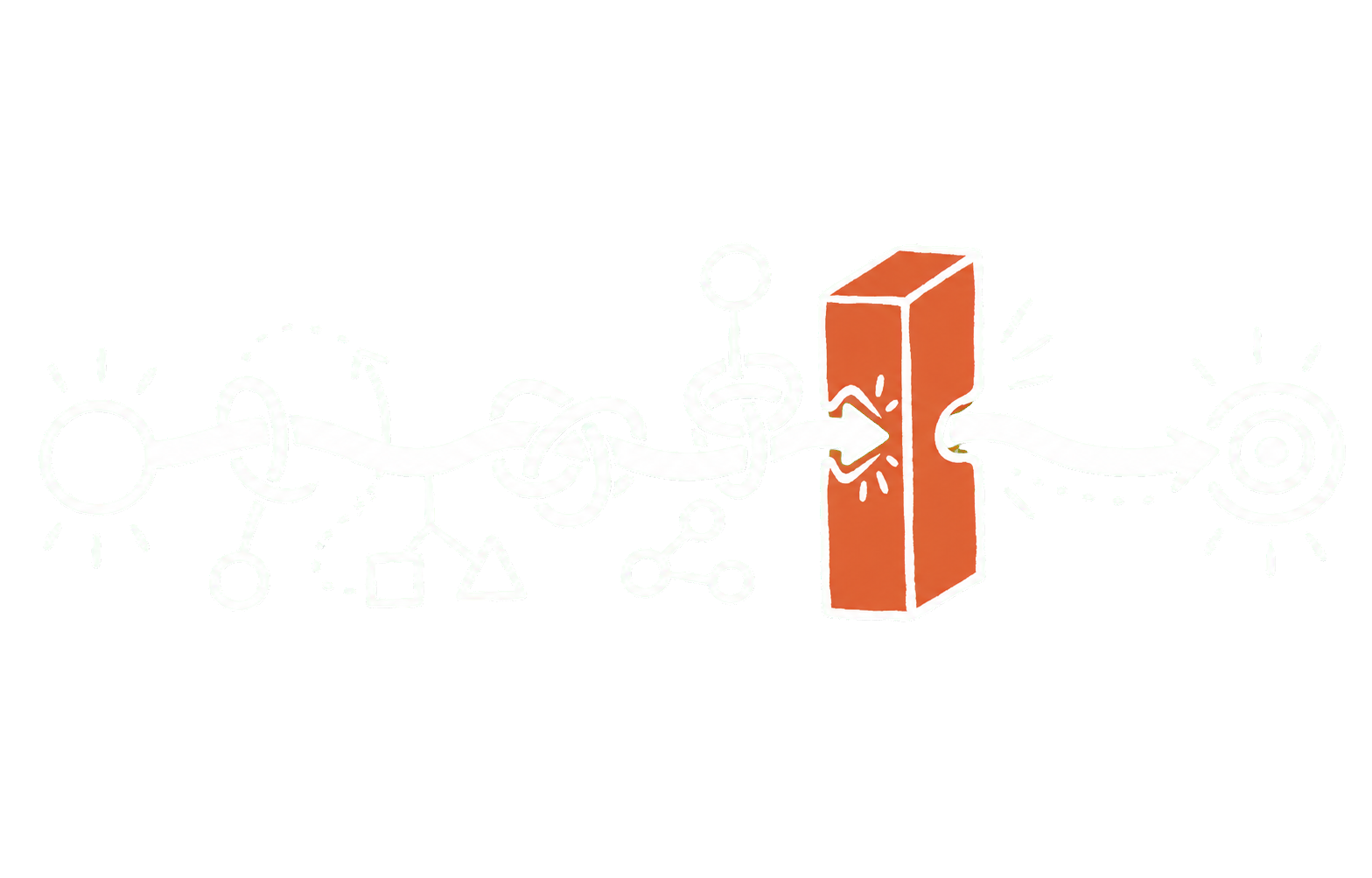
Execution Drag is the cumulative loss of speed and effectiveness caused by unclear ownership, overloaded processes, weak coordination and unresolved dependencies. No single obstacle may appear decisive. The drag comes from the combined effect of waiting, hand-offs, rework and divided attention across the path from strategic choice to delivered outcome.
Execution drag grows when the organization measures how much work has started rather than how effectively important work flows to completion.
Where this principle sits
Execution Drag belongs to the Enabling Execution family of principles. It is related to Strategic Friction, but the concepts are different. Strategic Friction describes features of the operating environment that resist the strategy. Execution Drag describes the cumulative effect those obstacles, dependencies and overloaded workflows have on delivery.
It also interacts with Decision Velocity. Slow or repeatedly reopened decisions keep work unresolved and increase the number of activities teams must carry simultaneously. The resulting congestion then makes subsequent decisions and execution even slower.
The central question is: where does strategically important work spend time without moving meaningfully closer to completion?
Drag consumes capacity without appearing as failure
Execution Drag is difficult to see because much of its cost looks like legitimate work. People attend coordination meetings, prepare status reports, manage dependencies and respond to escalations. Calendars are full and utilization appears high. Yet the organization is spending a growing share of its capacity managing the movement of work rather than producing the outcome.
The visible cost is delay. The less visible cost is lost focus. When work waits, teams begin other tasks to remain productive. Work in progress grows, attention fragments and completion becomes even less predictable. Leaders respond by launching recovery plans, adding governance or requesting more frequent reporting, which can increase the same coordination load that caused the problem.
Drag also weakens accountability. An initiative that crosses several functions may have a named sponsor but no one with control over the end-to-end result. Each team delivers its portion and explains why the remaining delay sits elsewhere. Local performance can look acceptable while the customer or strategic outcome continues to miss expectations.
Over time, the organization normalises heroic effort. Experienced people learn which relationships, escalations and unofficial workarounds are required to move work. Their skill conceals the poor design of the system. When they leave or priorities multiply, performance deteriorates because execution depended on personal navigation rather than reliable flow.
The strategic cost is opportunity. Slow execution reduces the number of ideas an organization can test, delays benefits and makes plans obsolete before they are delivered. A strategy that takes too long to become real is exposed to changing markets, competitors and assumptions. Execution speed is therefore not simply operational efficiency; it determines how quickly the organization can learn and adapt.
How execution drag accumulates
Drag grows through several mechanisms that appear manageable in isolation but reinforce one another across the delivery system.
Ownership is divided across activities
Functions own tasks while no one controls the complete outcome. Each hand-off creates waiting, interpretation and an opportunity for priorities to diverge. When performance falls short, accountability is distributed across the same boundaries that prevented decisive action.
Too much work enters the system
Organizations approve more initiatives than their constrained resources can complete. Starting work signals responsiveness, while stopping or delaying it creates visible conflict. The result is high work in progress, frequent switching and long queues around specialist teams and decision makers.
Dependencies remain implicit
Plans describe milestones but underestimate the people, systems and decisions required from other teams. Dependencies become visible only when work reaches them. A delayed input then affects several downstream activities, forcing teams to replan and creating further coordination.
Processes optimize control rather than flow
Governance is often designed around functional assurance: each group reviews the work from its own perspective. The individual checks may be sensible, but their sequence creates repeated submissions, contradictory feedback and long approval cycles. No one is accountable for the total time or value added across the process.
Priorities change without clearing old work
New requests are added to existing commitments. Teams continue earlier work because budgets, measures and stakeholders remain attached to it. The portfolio expands while capacity does not, turning every new priority into another source of delay.
Problems are solved downstream
Weak requirements, unclear decisions and quality issues are allowed to pass to the next stage. Rework appears later, when correction is more expensive and more teams are involved. Local speed creates system-wide drag.
Reporting substitutes for intervention
When leaders cannot see flow directly, they ask for more status information. Teams spend time explaining delay rather than removing its causes. Red and amber indicators accumulate while ownership for resolving the central constraint remains unclear.
The mechanisms create a congestion loop. Overcommitment increases waiting; waiting encourages teams to start additional work; more work increases dependencies and reporting; and greater coordination load further reduces completion. Breaking the loop requires limiting work in progress, clarifying end-to-end ownership and improving flow at the system’s primary constraint.
Toyota: designing execution around flow
Toyota provides a practical example of reducing Execution Drag by treating performance as the flow of value through a system rather than the utilization of isolated activities. The Toyota Production System seeks to expose waiting, excess work, unevenness, rework and overburden so that problems can be addressed where they occur.
Several practices support this approach. Work is standardized enough for abnormal conditions to become visible. Production is connected to actual demand, limiting the accumulation of work between stages. Visual management allows teams to see the current state of the system. When a quality problem appears, stopping to address it can protect overall flow by preventing defects and rework from traveling downstream.
This can look slower at the point of interruption. A team pauses, investigates and corrects the cause instead of preserving immediate output. Yet continuing with a hidden problem creates inventory, later repair and wider disruption. Toyota’s approach distinguishes local activity from system performance: the objective is not to keep every resource busy at every moment, but to deliver reliable value through the entire process.
The principle applies beyond manufacturing. A strategy process can limit work entering review. A technology team can make dependencies visible and reduce hand-offs. A customer journey can be measured by total elapsed time rather than the processing time of each function. In each case, leaders examine where work waits, returns or accumulates instead of asking only whether individual teams are productive.
The deeper lesson is that flow must be managed end to end. Improvements within one function can shift delay elsewhere or increase the load on a constraint. Execution Drag falls when the organization improves the system experienced by the work, not merely the performance reported by its parts.
Improve the constraint, not the appearance of activity
Eliyahu Goldratt provides the clearest foundation for Execution Drag in The Goal. His theory of constraints shows that the output of a system is governed by its limiting constraint. Improving activity elsewhere may increase inventory and complexity without increasing the rate at which the system achieves its goal.
This challenges a common management instinct. When delivery is slow, leaders push every team to work faster and maximize utilization. If the constraint cannot absorb the additional work, queues grow and lead times lengthen. The system appears busier while completion becomes less predictable. The more effective response is to identify the constraint, protect it from poor-quality inputs and organize the rest of the system around its flow.
W. Edwards Deming adds the importance of understanding performance as the product of a system. Variation, quality and delay cannot be improved sustainably by demanding greater effort from individuals operating within the same conditions. Leaders must examine how processes, measures and dependencies interact, then change the system that repeatedly produces the result.
Together, these perspectives reveal why local optimization creates execution problems. A function can meet its utilization or output target while increasing waiting and rework for the organization. End-to-end flow, total completion time and delivered outcomes provide a more useful view. The purpose is not to remove all spare capacity; some capacity is necessary to absorb variation and protect the constraint. The objective is a system that completes important work reliably.
Signals to watch
- Work spends more time waiting between stages than being actively developed.
- Teams carry many initiatives but complete relatively few.
- Named owners coordinate activity without authority over end-to-end outcomes.
- Specialist teams and decision makers have persistent queues around them.
- Dependencies are discovered after delivery commitments have been made.
- New priorities are added without stopping or completing existing work.
- Quality problems and unclear requirements generate repeated downstream rework.
- Status reporting grows while the same constraints remain unresolved.
Questions for leaders
- Where does important work wait, queue, return or lose ownership?
- What is the current constraint governing end-to-end completion?
- How much work is in progress relative to the organization’s capacity to finish it?
- Who owns the complete outcome across functional boundaries?
- Which approvals or hand-offs add value, and which exist mainly through habit?
- What work should stop or wait to allow priorities to flow?
- Are local measures improving one function while slowing the overall system?
- What recurring workaround is concealing a structural execution problem?
The takeaway
Execution Drag is the cumulative delay created by overloaded workflows, divided ownership, hidden dependencies and local optimization. Leaders reduce it by limiting work in progress, clarifying end-to-end accountability, making queues visible and organizing the system around its primary constraint.
Execution improves when leaders stop asking how to keep every part busy and start asking how important work can flow reliably to completion.